GuidesDecision Guide
Do You Need Two Coats of Paint?
Two coats are a useful estimating default, but they are not a universal rule. Coat count depends on the paint, surface, color change, primer, and finish you want.
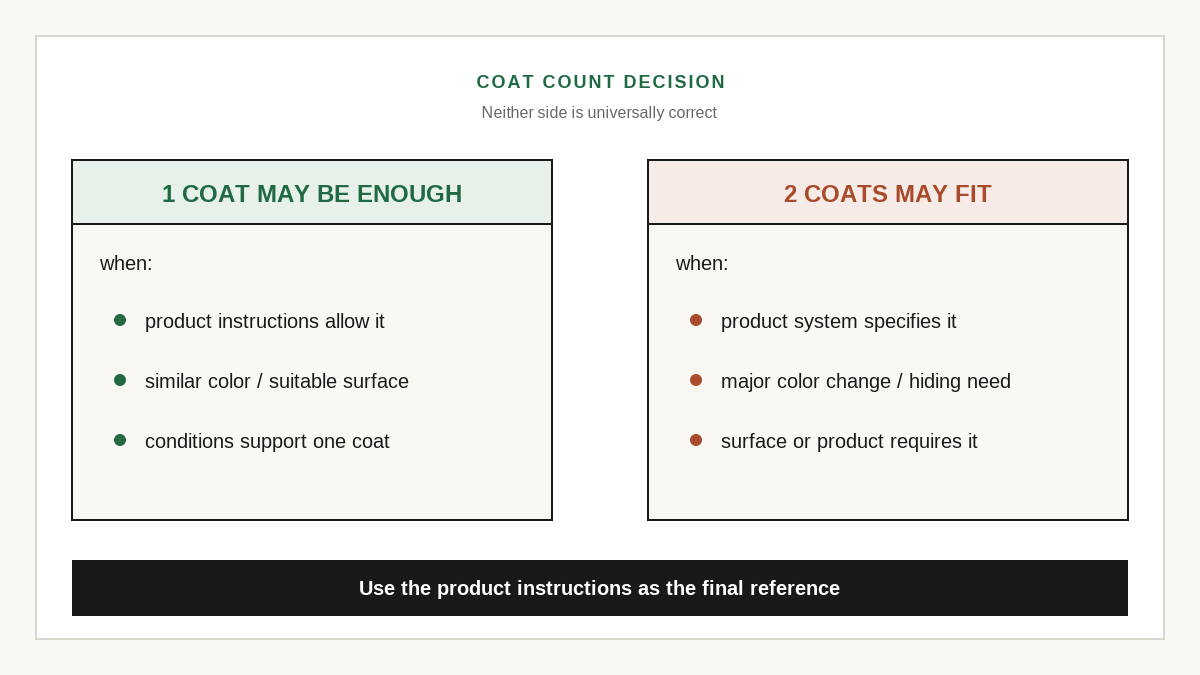
Two coats are a useful estimating default, but they are not a universal rule. The number of coats depends on the paint, surface, color change, primer, and finish you are trying to achieve.
For estimating, an editable coat count is more useful than promising that one-coat or two-coat coverage applies to every wall. The FixUpWise Paint Calculator starts at 2 coats for that reason — change the field to match your plan.
When two coats are commonly appropriate
Manufacturer signals that often point toward two finish coats:
- Benjamin Moore’s online calculator assumes two coats for its rough estimate
- Some Benjamin Moore product sheets (for example Regal Select) recommend two coats for full color development on that product
- Large color changes, uneven previous finishes, or a goal of uniform sheen
When one coat may be sufficient
- Similar color over a sound, previously painted wall
- A product labeled or tested for one-coat hide in specified colors — still follow that product’s instructions
- A proper primer system that improves hide before the finish coat
One coat is a project decision supported by the product and surface, not a shortcut that applies to every wall.
Situations that may require more work
Behr’s interior buying guidance notes additional coats (or more paint) may be needed for porous, rough, textured, previously unpainted surfaces, or dramatic color changes. Sherwin-Williams notes requirements vary with application method and surface condition.
Bare drywall, heavy repairs, and strong hue shifts often mean primer plus more than a single finish coat.
How coat count changes quantity
gallons = paintable area × coats ÷ coverage
Using 352 sq ft of wall (10×12×8 example from how much paint for a room) at 350 sq ft/gal:
| Coats | Coated sq ft | Calculated gallons | Whole gallons |
|---|---|---|---|
| 1 | 352 | ≈ 1.01 | 2 |
| 2 | 704 | ≈ 2.01 | 3 |
Doubling coats doubles coated square footage at the same coverage. Purchase rounding can still jump by a full gallon.
Primer is not a substitute “coat of paint” in the wall-paint field — estimate primer with its own coverage if needed.
Product instructions beat generic rules
The label and technical data for the paint you buy outrank any site-wide default. Coverage rates that feed the same formula are covered in how many square feet a gallon covers.
Decision checklist
| Situation | What to check |
|---|---|
| Similar color over sound painted wall | Product instructions / coverage |
| Major color change | Hiding performance, primer, additional coats |
| New / porous surface | Primer / product requirements |
| Specialty paint | Manufacturer system instructions |
Related reading
Sources
- Benjamin Moore — Paint Calculator — Benjamin MooreCalculator assumes two coats for its rough estimate; does not include ceiling
- Benjamin Moore — Regal Select technical data (N549) — Benjamin MooreExample product recommends two coats for full color development
- Behr — Determine how much interior paint to buy — BehrNotes additional coats may be needed for porous, textured, unpainted, or dramatic color-change surfaces
- Sherwin-Williams — Paint Calculator FAQ — Sherwin-WilliamsProduct requirements vary by application method and surface type or condition